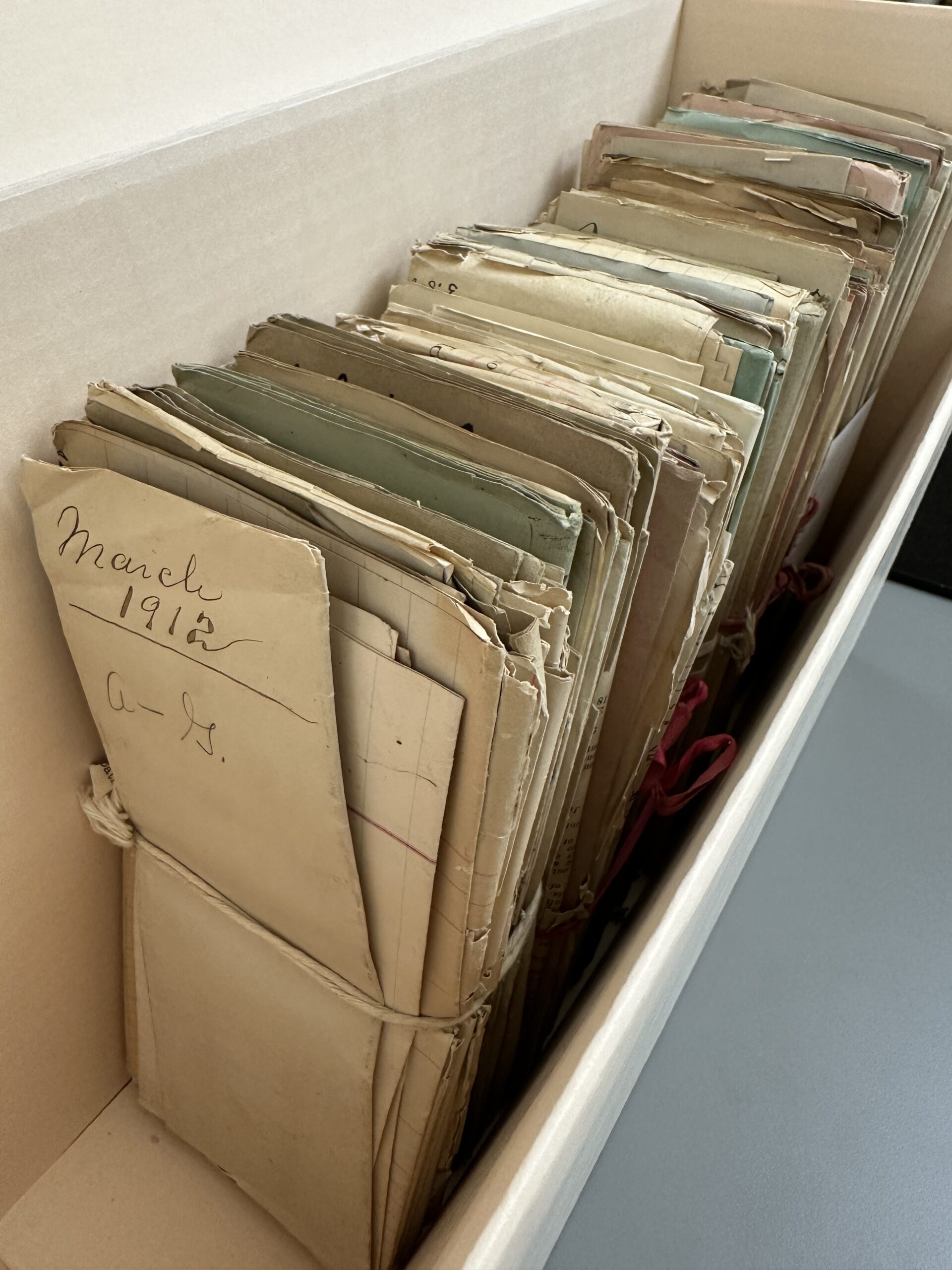
Our class time working with AI for transcriptions reassured me that my skills of transcription, historical document editing, and being able to read cursive handwriting are still important. Before class I had zero interest in using AI to transcribe, but now I see how someone may find it useful if parsing through a large corpus of documents to determine how close to read them or as a better than nothing scenario as with the Papers of the War Department project. As I work to transcribe all the letters to and from Fairfax’s Freedmen’s Bureau to create an index and database for researchers, it comforts me to know that I should finish before AI gets good enough to do the same.
Ahh the topic of citations. Historians not citing articles because the standard for scholarship is the academic monograph makes sense to me, but I could not imagine changing a digital article’s citation format into the print version.[1] I just do not see the point in that. These databases have paywalls for a reason, unfortunately, and being able to justify keeping them alive means they need to show people are using and referencing them. As for URLs, I personally just put the database where I retrieved an article, but when it is a website, the URL is necessary. The reason I choose to cite books as if I use the physical version is because I consider them different than journal articles. It is hard to get over the thought that engaging with the hard copy of a book is more prestigious than the digital version. Even when I use a digital surrogate, I reference the index, read the introduction and conclusion, and analysis the chapter titles. If I have not found what I am looking for then I will do a keyword search.
Putnam’s article illuminated how digitized sources can be positive and negative. What stood out to me was the sense of place that gets lost with using only digitized sources. My biggest take away was the quote “distinguishing the window from the why will be crucial.”[2] Keyword searchability removes the sense of scope that is important. I need to be sure to keep in mind that if something only shows up five times in my newspaper search, it may not be as important as I think it was.
I had not considered how much more digitized newspapers are cited than those still on microfilm or not digitized at all. A light bulb went off that answered my question about the lack of visibility Fairfax County receives in academic literature, it is because the court archive requires an in person visit! At least that leaves a gap in the scholarship for me to address in my own work.
Overall, I found this week’s material and discussion useful. I am glad that most of the sources I encounter are out of copyright (sorry 20th century folks). The overview and definitions Schoch provides for different data models will sure be important as we add to our digital toolbox throughout the semester.[3]
[1] Jonathan Blaney and Judith Siefring, “A Culture of non-citation: Assessing the digital impact of British History Online and the Early English Books Online Text Creation Partnership,” Digital Humanities Quarterly 11, 2017, 2.
[2] Lara Putnam, “The Transnational and the Text-Searchable: Digitized Sources and the Shadows They Cast,” The American Historical Review 121, no. 2 (2016), 392. JSTOR.
[3] Christof Schoch, “Big? Smart? Clean? Messy? Data in the Humanities,” Journal of Digital Humanities 2, no. 3 (2013). Big? Smart? Clean? Messy? Data in the Humanities · Journal of Digital Humanities.
Andrew, you also paid attention to some of the same points and found them interesting, which I wrote about as well.
From testing handwriting transcription, what I have realized is that for non-English scripts, Google Translate still works better than artificial intelligence tools. You can simply give it a screenshot of the handwriting, and it will usually return a fairly accurate transcription with only a few errors.
Hi Andrew,
Putnam’s arguments about keyword searchability stood out to me as a limitation not only of digital research but also of how historical information is organized in databases in general. Keyword searchability, whether through automated OCR or physical archives’ indexing systems, will never be a comprehensive way to find all the information you are looking for that exists in the database. Of course, keyword searching is much faster than going through all the information, but you risk missing relevant information that was not indexed or uses different phrasing than your search term. For historians, gathering the surrounding context of the topic will always be necessary alongside and to improve keyword-searching methods.
Though AI’s handwriting recognition ability continues to improve, I understand your reluctance to use it to transcribe documents from the Fairfax Freedmen’s Bureau. Researchers who utilize your database in the future will surely appreciate your thoroughness, care, and cursive reading skills. Your mentality towards AI transcription is probably the best one to have: it’s truly a “better than nothing” scenario. If you have the skills, resources, and ability to hand-transcribe, I see no reason not to!
Andrew – incredible work you’re doing! Do you ever run into cases where you cannot read what’s in a letter? Did you try using Claude on one of those? (Asking because it was helpful in my case.) I think the model for the foreseeable future will continue to be one of joint human and AI effort; it’s too important to have that human in the loop. Also, I made a mental note about the lightbulb moment you had – that digitization has given outsized influence to digitized newspapers vs. those still on microfilm or paper, and what this says about the research we have been producing and its probable gaps and biases. These questions should be a part of our checklist as historians when we take on new research: What’s easily available? What’s not but has been referenced and could be important? What hasn’t been referenced at all but could be important to look at? What sources don’t exist for reasons that are important to the story?
Hi Karine,
Thanks for your comment! At work when we encounter something that is essentially illegible it becomes a team effort. Besides asking each other for opinions on the writing, we utilize the tools available. We look through other examples of that person’s handwriting to try to find other examples of the text in question (usually a letter or two). If it is a name, our deed and will indexes are keywork searchable so look for any matches there. If we cant figure it out we put the illegible text in square brackets in our transcription to acknowledge it needs to be revisited.